
Autumn 2
English (Literacy Tree)
After experiencing an engaging starting point of looking at, talking about and making predictions about a range of hats, the children read the book 'I Want My Hat Back' by Jon Klassen. Through role-play, children explore the characters’ feelings. They create a short dialogue between the two main characters, Bear and Rabbit, and discuss who has Bears' hat. Children develop upon their overgrowing skills set in English and apply their knowledge of adjectives when describing a variety of hats and also learn to ask and write questions.
Our second book sees an exciting introduction to the story Billy and the Beast by Nadia Shireen, where chi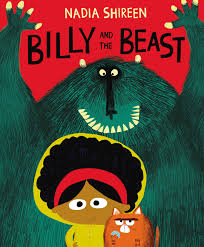 ldren begin by exploring the front cover and making predictions about the characters and plot. They generate their own questions about the story, such as “Is the beast mean?” and “Why does the cat look grumpy?”, developing curiosity and comprehension skills.
As the story unfolds, children focus on grammar and sentence structure. They learn about the suffix –ed to form past tense verbs, sorting words like painted, jumped, and called by their sounds. Building on this, pupils create noun phrases to describe characters and animals, for example “the spiky hedgehog” and “the fat cat”. Later, they combine these skills to write sentences using both a noun phrase and a past tense verb, such as “The terrible beast picked up the fox by his tail.”
Through role-play and oral retelling, children deepen their understanding of the narrative and practise sequencing events. These activities help them apply growing knowledge of adjectives, verbs, and sentence construction, while fostering creativity and confidence in writing.
Maths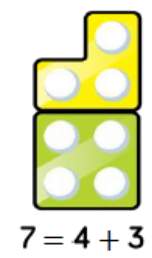
In Autumn 2 we progress onto discussing the numbers 6-10, looking at how we can represent them by using the 'five and a bit structure' and work systematically to partition them. Children become skilled in using part-whole models to support their partitioning and are aware of how to confidently use Numicon as a helpful problem solving tool.
With children becoming increasingly confident with their partitioning, we then begin to learn about additive structures. Children will learn to combine two or more parts to make a whole and understand that addends can be represented in any order – also called the communicative law.
Phonics (Little Wandle)
In Autumn 2 children delve further into Phase 5, learning more GPCs, including split digraphs!
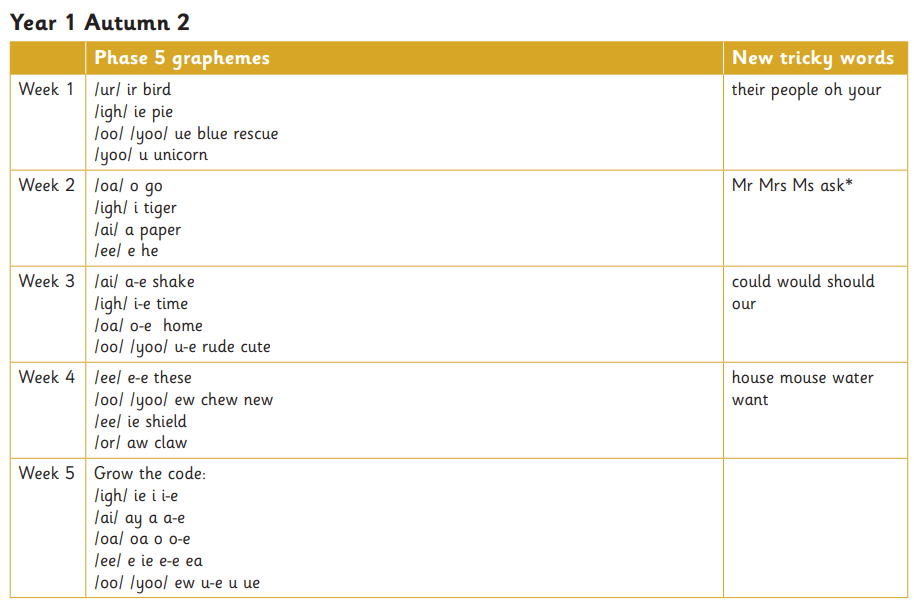
*If you are unsure on how to pronounce some of these GPCs then please ask your child's class teacher and we can support you so that you can support your child.